Moderate
Home energy in Arizona: prices, solar export rates and rebates
You buy power from the utility that serves your address, rooftop solar exports earn a yearly export rate instead of the retail rate, and the state's home energy rebates have had a stop-start history.
By VoltHearth Editorial Team Updated 6 min read
- Electricity price
- 15.26¢ per kWh
- Natural gas price
- $18.58 per Mcf
- Pick your supplier
- No, utility-set rates
- Net metering
- Yearly export rate
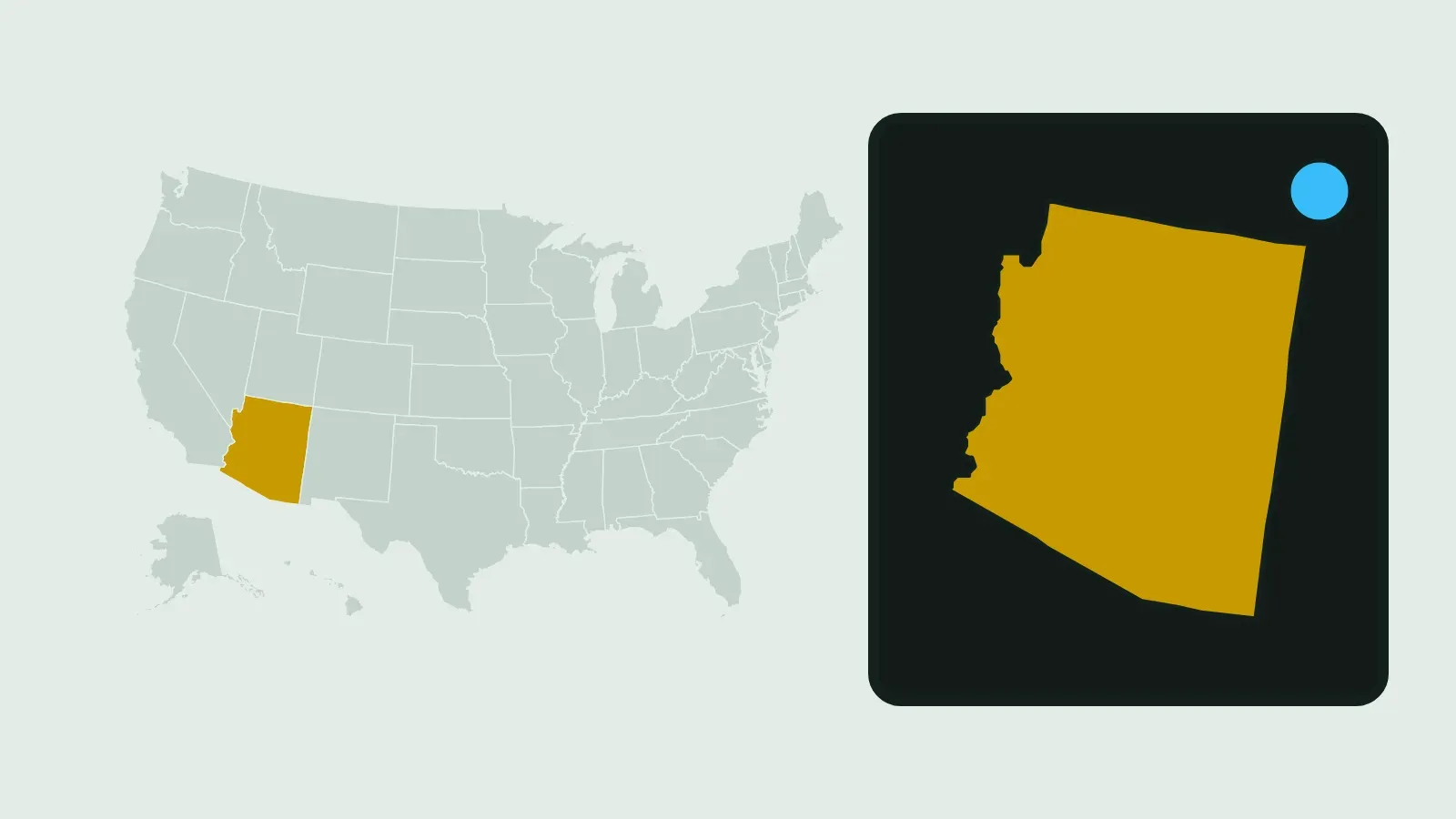
At a glance
Arizona households paid an average of 15.26¢ per kWh for electricity in 2025, below the national average, and $18.58 per thousand cubic feet for natural gas, above it. EIA data show no energy-only electricity suppliers selling in Arizona in 2024, so your rate comes from your utility. New rooftop solar customers are paid a Resource Comparison Proxy (RCP) export rate that is reset every year. The state's Efficiency Arizona rebates were paused in February 2025, and VoltHearth could not confirm their current status.
Arizona at a glance
What Arizonans pay for electricity and gas
The U.S. Energy Information Administration (EIA) reports statewide averages: total residential revenue divided by kilowatt-hours sold, so delivery charges and fees are inside the figure. Your own rate depends on your utility, rate plan and season, so treat these as a yardstick, not a quote.
| Energy and year | Arizona | U.S. |
|---|---|---|
| Electricity 2025 (¢ per kWh) | 15.26 | 17.23 |
| Electricity 2024 (¢ per kWh) | 14.91 | 16.48 |
| Natural gas 2025 (dollars per Mcf) | 18.58 | 15.34 |
| Natural gas 2024 (dollars per Mcf) | 20.47 | 14.50 |
At 15.26¢, a month with 1,000 kWh of use comes to about $153. Arizona electricity rose about 2% between 2024 and 2025 (14.91¢ to 15.26¢) and stayed about 11% below the U.S. average. Gas fell about 9% in a year, from $20.47 to $18.58 per Mcf, and still ran about 21% above the U.S. figure. One Mcf holds roughly 10.37 therms, so $18.58 per Mcf is about $1.79 per therm; the kWh, therm and ccf guide explains the units on your bill.
Who sells you electricity
Arizona households do not shop for an electricity supplier. EIA's 2024 Arizona profile lists energy-only provider sales of zero: every kilowatt-hour was sold by a full-service utility that also delivers it. Your bill names that utility.
- Investor-owned utilities: the Arizona Corporation Commission (ACC) names Arizona Public Service and Tucson Electric Power as electric utilities it regulates, and Southwest Gas as a gas utility.
- Cooperatives: the ACC says it also regulates utility cooperatives, and names Graham County Electric Cooperative and Mohave Electric Cooperative as examples.
- City-owned utilities: the ACC says many cities own and run their own utilities and that it generally lacks jurisdiction over them.
Rates inside one utility vary by plan. The time-of-use rates guide shows how a plan that charges more in late afternoon changes a bill.
Solar panels and what the utility pays you
Arizona does not credit new rooftop solar exports at the retail rate. Utilities instead pay an export rate called the Resource Comparison Proxy (RCP), which the commission approves and the utility resets each year. Customers on the older net metering rate stay on it for a limited period. APS says the current buyback rate lasts 20 years from the date a system was connected, and that its export rate is reviewed each year and approved by the ACC.
Tucson Electric Power posts its figure. Its RCP is $0.0462 per kWh from October 1, 2026 through September 30, 2027. TEP says the rate cannot drop more than 10% in a year, applies to residential and small commercial customers who requested interconnection on or after September 20, 2018, and is paid at the rate in place when you requested interconnection, for up to 10 years.
When an older solar buyback period ends at APS
APS sends customers a notice about 60 days before they move from the older net metering rate (Legacy EPR-6) to the RCP, and they must choose a rate plan. Under the RCP they still receive monthly bill credits for excess solar energy, and unused credits roll over month to month. At year-end, a balance of $25 or more is mailed as a check; a smaller balance carries into the next year. APS lists three plan choices: time-of-use 4 to 7 p.m. weekdays, the same with a demand charge, or an EV overnight plan. Without a choice, you default to the time-of-use plan with the 4 to 7 p.m. weekday window.
Home energy rebates
The Governor's Office of Resiliency runs Arizona's federally funded home energy rebates under the name Efficiency Arizona. On February 27, 2025, the office announced that the programs, funded by the Department of Energy's home energy rebates, were paused because federal grant funding was withheld and not consistently available. A separate notice said the programs were paused until federal funding is made available. Neither notice gives a resumption date.
The program's own website, which carries a 2026 copyright and no status date, still lists income-based eligibility screening and rebates of up to $14,000 per household, with item limits such as up to $8,000 for a heat pump and up to $1,750 for a heat pump water heater. VoltHearth could not confirm from an official source whether money is flowing now. Check with the program before you start work you hope a rebate will cover. The HOMES and HEAR guide explains how the programs work.
Who to call
- Electricity and natural gas: the Arizona Corporation Commission regulates investor-owned electric and gas utilities and some cooperatives.
- Rebates: the Governor's Office of Resiliency, through Efficiency Arizona.
Quick answers
Can I choose my electricity provider in Arizona?
No. EIA's 2024 profile shows no energy-only supplier sales in Arizona, so your utility both sells and delivers your power. Your bill names the utility that serves your address.
Does Arizona have net metering?
Not for new systems in the usual sense. Utilities pay an RCP export rate that is reset each year, and older net metering customers move to it when their buyback period ends. Ask your utility for the current rate and the number of years it is locked in.
Are Arizona home energy rebates available now?
Unconfirmed. The Governor's Office of Resiliency paused Efficiency Arizona in February 2025 and gave no resumption date in the notices VoltHearth found. The program website still lists eligibility screening, so check it directly.
Why is my Arizona gas price higher than the U.S. average?
EIA's 2025 average for Arizona households was $18.58 per Mcf against $15.34 nationally. Delivery charges, distance from supply and fixed monthly charges all feed a utility's average, and your own rate depends on the utility serving you.
Sources
- EIA — Electric Power Annual, Table 2.10, average price by state
- EIA — Average residential natural gas price by state
- EIA — Arizona electricity profile 2024
- Arizona Corporation Commission — Utilities
- Tucson Electric Power — Resource Comparison Proxy export rate
- APS — Solar energy credit transition FAQ
- Arizona Governor's Office of Resiliency — Efficiency Arizona program paused (February 27, 2025)
- Efficiency Arizona — rebate program site
Prices are EIA statewide averages. Facts on this page were checked against these sources on November 19, 2026. The rebate status could not be confirmed from a dated state page. Rebate programs and utility tariffs change; confirm with your utility and the Governor's Office of Resiliency before you act.
Read next
-

Bill guide
Time-of-use rates
How peak and off-peak pricing works, with a break-even example and questions to ask first.
-
Credits and rebates
HOMES and HEAR rebates
State-run DOE rebates and the May 2026 rule changes. Status differs by state.
-
State reading
Nevada
13.26¢ per kWh, down about 12% in a year; net metering at 75% of retail; rebates not open.