Low
Home energy in Arkansas: prices, solar credits and what is open
Electricity in Arkansas costs less than the U.S. average and comes from your own utility, a 2023 law reset how rooftop solar exports are credited, and home energy rebates are not available yet.
By VoltHearth Editorial Team Updated 6 min read
- Electricity price
- 12.87¢ per kWh
- Natural gas price
- $19.25 per Mcf
- Pick your supplier
- No, utility-set rates
- Net metering
- Net billing since 2023
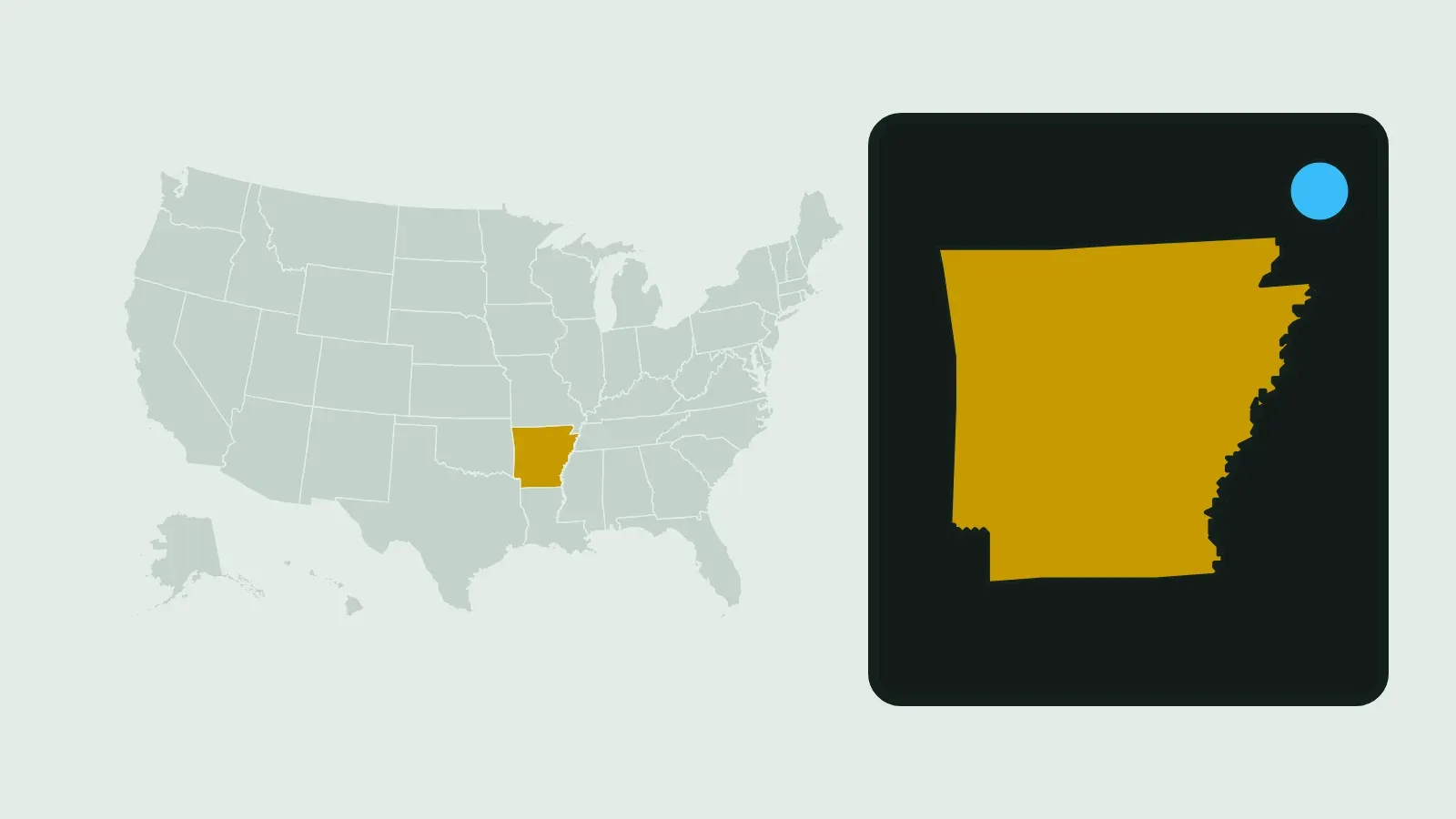
At a glance
Arkansas households paid an average of 12.87¢ per kWh for electricity in 2025, about 25% below the national average, and $19.25 per thousand cubic feet for natural gas, about 25% above it. EIA data show no energy-only electricity suppliers selling in Arkansas in 2024, so your rate comes from your utility. A 2023 law lets a utility credit rooftop solar exports either at its avoided cost or by netting kilowatt-hours with a monthly grid charge. The state's home energy rebates were not available on the state's page.
Arkansas at a glance
What Arkansans pay for electricity and gas
The U.S. Energy Information Administration (EIA) reports statewide averages: total residential revenue divided by kilowatt-hours sold, so delivery charges and fees are inside the figure. Your own rate depends on your utility, rate plan and season, so treat these as a yardstick, not a quote.
| Energy and year | Arkansas | U.S. |
|---|---|---|
| Electricity 2025 (¢ per kWh) | 12.87 | 17.23 |
| Electricity 2024 (¢ per kWh) | 12.32 | 16.48 |
| Natural gas 2025 (dollars per Mcf) | 19.25 | 15.34 |
| Natural gas 2024 (dollars per Mcf) | 16.09 | 14.50 |
At 12.87¢, a month with 1,000 kWh of use comes to about $129. Arkansas electricity rose about 4% between 2024 and 2025 (12.32¢ to 12.87¢). Gas moved faster: Arkansas households paid about 20% more per Mcf in 2025 than in 2024, and about 25% more than the U.S. average. One Mcf holds roughly 10.37 therms, so $19.25 per Mcf is about $1.86 per therm; the kWh, therm and ccf guide explains the units on your bill.
Who sells you electricity
Arkansas households do not shop for an electricity supplier. EIA's 2024 Arkansas profile lists energy-only provider sales of zero: every kilowatt-hour was sold by a full-service utility that also delivers it. Your bill names that utility. The Arkansas Public Service Commission (PSC) sets the rules for net-metering customers of the utilities it regulates, and the 2023 law says municipal utilities set their own limits through their governing bodies.
Compare your bill with the electric bill guide and the rate structures guide to see which charges are fixed and which move with use.
Solar panels and what the utility pays you
Act 278 of 2023, signed March 13, 2023, amended the state's net-metering law and renamed it the Arkansas Renewable Energy Development Cost-Shifting Prevention Act of 2023. The act text says a utility chooses between two ways to treat a customer's exports.
- Avoided cost: exported kilowatt-hours are valued at the utility's avoided cost, which is what the utility would otherwise pay to supply that power.
- Netting with a grid charge: exports offset your use in kilowatt-hours, and a monthly grid charge applies. Excess credits carry forward to later billing cycles and do not expire.
- Size limit: for a home, the lesser of 25 kW AC or 100% of your highest monthly usage in the prior 12 months.
- Existing systems: some systems with interconnection agreements submitted after July 24, 2019 and before December 31, 2022 can keep the rate structure in effect when their agreement was signed, for up to 20 years, subject to commission approval.
As an illustration of the netting arithmetic only: a month with 600 kWh used and 750 kWh generated nets to 150 kWh of credit carried forward, and the monthly grid charge still applies. The act leaves the actual rates to the PSC and the utility, so VoltHearth does not quote one. Get your utility's tariff in writing and run it through the solar payback calculator. The federal solar credit ended for systems finished after December 31, 2025; what happened to 25C and 25D explains what is left.
Protections for solar buyers
The same act added a Customer Protections for Net-metering Customers Act. It requires sellers and lessors of net-metered systems to give customers disclosures, safety and permit documentation, and a bond or other financial security. The Attorney General can enforce violations. Ask any seller or lessor for those documents before you sign, and keep copies.
Home energy rebates
The Arkansas Energy Office, part of the Division of Environmental Quality (ADEQ), publishes the state's home energy rebates page. It says: "At this time, the Home Energy Rebates Program is not available in Arkansas." It lists an allocation of approximately $105 million and says the program targets low-income households (below 80% of area median income) and moderate-income households (80% to 150%), in single-family homes and multifamily buildings.
The page shows no update date, gives no launch date and states no per-household amounts. It says projects started on or after August 16, 2022 may qualify for retroactive rebates if they meet federal and state requirements, and that this is not guaranteed. Federal rules allow up to $8,000 for HOMES and up to $14,000 per household for HEAR; a state sets its own limits. Questions go to [email protected]. The HOMES and HEAR guide explains the programs.
Who to call
- Electricity: the Arkansas Public Service Commission, which under the 2023 law sets net-metering rates, terms and conditions.
- Rebates: the Arkansas Energy Office at ADEQ.
Quick answers
Can I choose my electricity provider in Arkansas?
No. EIA's 2024 profile shows no energy-only supplier sales in Arkansas, so your utility both sells and delivers your power. Your bill names the utility that serves your address.
Does Arkansas have net metering?
Arkansas law, as amended by Act 278 of 2023, lets a utility credit exports at avoided cost or net kilowatt-hours with a monthly grid charge. Which one you get, and the rate, is in your utility's tariff.
Are Arkansas home energy rebates available now?
Not according to the Arkansas Energy Office page, which says the program is not available and shows no launch date. Check the page before you start work you hope a rebate will cover.
Why is my Arkansas gas price higher than the U.S. average?
EIA's 2025 average for Arkansas households was $19.25 per Mcf against $15.34 nationally. Delivery charges, distance from supply and fixed monthly charges all feed a utility's average, and your own rate depends on the utility serving you.
Sources
- EIA — Electric Power Annual, Table 2.10, average price by state
- EIA — Average residential natural gas price by state
- EIA — Arkansas electricity profile 2024
- Arkansas General Assembly — Act 278 of 2023 (net-metering)
- Arkansas Energy Office (ADEQ) — Home energy rebates
Prices are EIA statewide averages. Facts on this page were checked against these sources on November 19, 2026. The ADEQ rebate page shows no update date, and the rates under the 2023 law are set in utility tariffs that this page does not quote. Rebate programs and tariffs change; confirm with your utility and the Arkansas Energy Office before you act.
Read next
-
Bill guide
Net metering
How exported solar power is credited on a bill, how net billing differs, and where to find your rule.
-

Credits and rebates
Utility rebates
Where to look for your utility's rebates and what to confirm before you buy.
-
State reading
Louisiana
12.52¢ per kWh; your utility sells the power; solar exports at avoided cost; rebates in progress.