Highest
Home energy in California: prices, net billing and rebates
California has some of the highest electricity prices in the country, new rooftop solar customers of the big utilities are paid under a net billing tariff, and the rebate money is flowing in stages.
By VoltHearth Editorial Team Updated 7 min read
- Electricity price
- 31.35¢ per kWh
- Natural gas price
- $22.01 per Mcf
- Pick your supplier
- Partly (36% of sales)
- Net metering
- Net billing tariff
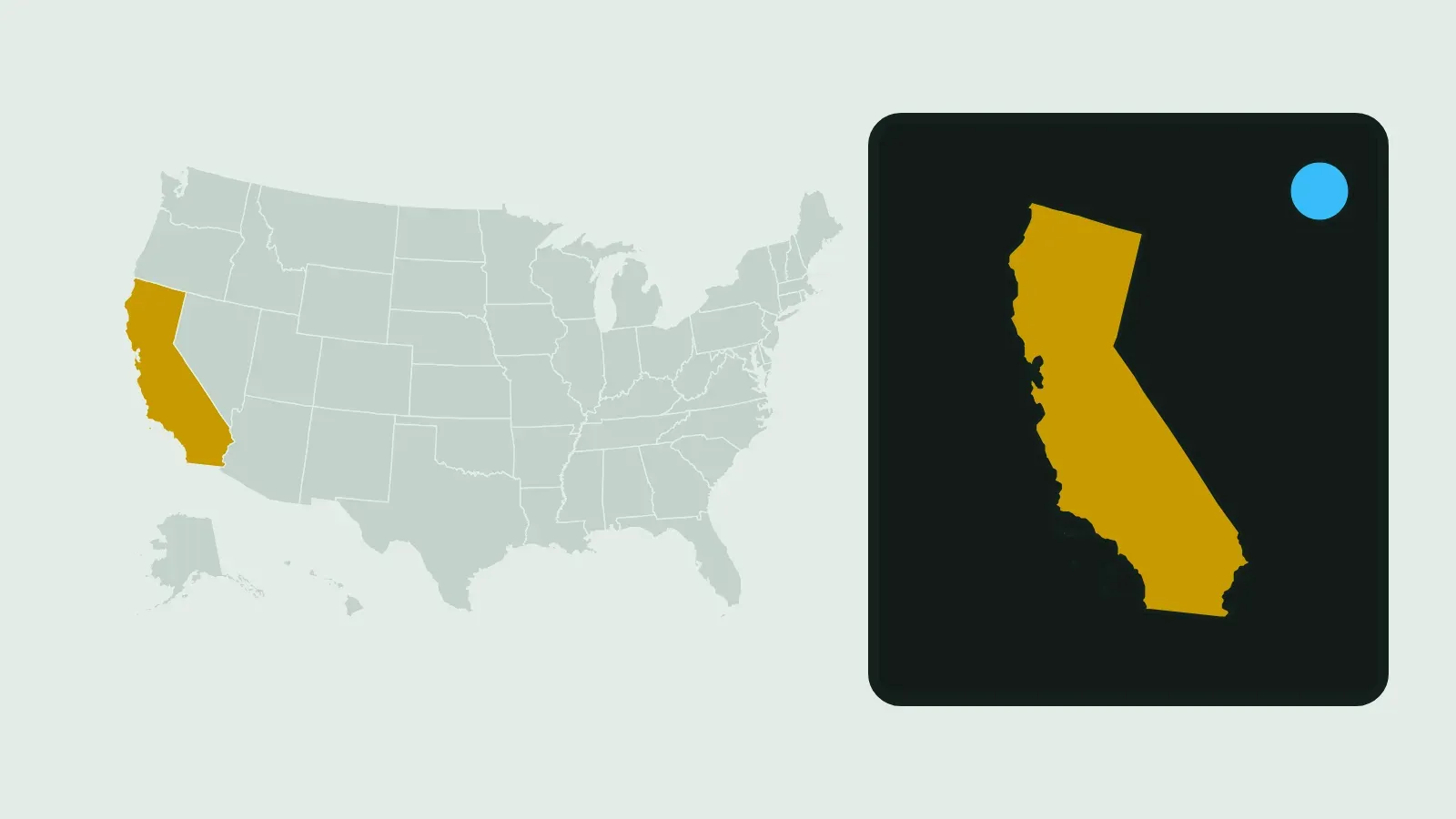
At a glance
California households paid an average of 31.35¢ per kWh for electricity in 2025, about 82% above the national average, and $22.01 per thousand cubic feet for natural gas, about 43% above it. In EIA's 2024 data, energy-only providers sold about 36% of the state's retail electricity, so many households buy supply from someone other than the company that delivers it. New rooftop solar customers of PG&E, SCE and SDG&E are paid under a Net Billing Tariff. The state's HEAR Phase I rebates are fully reserved, and HOMES rebates are available only through one program.
California at a glance
What Californians pay for electricity and gas
The U.S. Energy Information Administration (EIA) reports statewide averages: total residential revenue divided by kilowatt-hours sold, so delivery charges and fees are inside the figure. Your own rate depends on your utility, rate plan and season, so treat these as a yardstick, not a quote.
| Energy and year | California | U.S. |
|---|---|---|
| Electricity 2025 (¢ per kWh) | 31.35 | 17.23 |
| Electricity 2024 (¢ per kWh) | 31.97 | 16.48 |
| Natural gas 2025 (dollars per Mcf) | 22.01 | 15.34 |
| Natural gas 2024 (dollars per Mcf) | 19.14 | 14.50 |
At 31.35¢, a month with 1,000 kWh of use comes to about $313.50. California electricity slipped about 2% between 2024 and 2025 (31.97¢ to 31.35¢), while gas rose about 15%, from $19.14 to $22.01 per Mcf. One Mcf holds roughly 10.37 therms, so $22.01 per Mcf is about $2.12 per therm; the kWh, therm and ccf guide explains the units on your bill.
Who sells you electricity
California is a mixed market. EIA's 2024 profile shows 245.7 million megawatt-hours of retail sales, of which 89.6 million, about 36%, came from energy-only providers. Those sellers supply the power while another company, usually your local utility, delivers it and sends the poles-and-wires charges. EIA ranks the state second in the country for energy-only sales. The other 156.1 million megawatt-hours, about 64%, came from full-service providers that sell and deliver.
Your bill shows which company supplies your power and which delivers it. If the two differ, the supply charge and the delivery charge are set separately. The retail choice guide shows how to compare plans on the total bill at your own usage.
Solar panels and what the grid pays you
On December 15, 2022, the California Public Utilities Commission (CPUC) adopted a new rooftop solar tariff, which it calls the Net Billing Tariff. It applies to new rooftop solar customers of Pacific Gas and Electric, Southern California Edison and San Diego Gas and Electric. Exported electricity is credited at its value to the grid, which the CPUC defines by the avoided cost to the utility of buying clean electricity elsewhere. The credits are designed to favor exports in the late afternoon and early evening, especially in summer.
- Existing customers: the CPUC says the decision has no impact on existing rooftop solar customers and maintains their current compensation.
- Extra credits: the CPUC's 2022 announcement said residential customers who adopt solar in the following five years also get extra bill credits, guaranteed for 9 years. Ask your utility for the dates and amounts that apply now.
- Other utilities: the decision names the three utilities above. If another utility or a local public power system serves you, ask it for its own solar tariff.
Home energy rebates
The California Energy Commission (CEC) runs the state's share of the federally funded home energy rebates and lists a total award of $590 million. Its program page has no fixed update date, and its newest dated items are from November 2026. As of those items, the status is split.
- HEAR (called HEEHRA in California): Phase I launched in October 2024 through TECH Clean California. The CEC says Phase I rebates are fully reserved and no new reservations will be issued. Phase I allowed up to $8,000 for single-family households below 80% of area median income, up to $4,000 at 80% to 150%, and up to $14,000 per unit in multifamily buildings. Phase II, listed at $152 million, is not yet available.
- HOMES (renamed Home Owner Managing Energy Savings in June 2026): the CEC says rebates are available only through the Equitable Building Decarbonization Direct Install Program, which the Department of Energy approved for HOMES in November 2026. The Pay for Performance track has not received approval to launch.
The CEC lists $142.3 million of HOMES money for Direct Install and $90.8 million for Pay for Performance, excluding administrative funds. Federal rules allow up to $8,000 for HOMES and up to $14,000 per household for HEAR; the state's own limits are on the CEC page. The HOMES and HEAR guide explains how the programs work.
How to check a rebate offer
The CEC page warns that the HEAR program is not available to Californians right now and tells households not to share financial information with anyone offering to submit rebates for them. To check whether a contractor is part of a state program, email [email protected]. Contractors in the HEEHRA program must be TECH-certified and HEEHRA-trained, and the state's contractor finder lists them.
Who to call
- Electricity: the California Public Utilities Commission, which adopted the Net Billing Tariff for PG&E, SCE and SDG&E customers.
- Rebates: the California Energy Commission.
Quick answers
Can I choose my electricity provider in California?
Often, yes. EIA's 2024 profile shows energy-only providers sold about 36% of the state's retail electricity, so many households buy supply from a company other than their delivery utility. Your bill shows who supplies your power and who delivers it.
Does California have net metering?
For new rooftop solar customers of PG&E, SCE and SDG&E, the CPUC replaced it with the Net Billing Tariff in its December 15, 2022 decision. Existing customers keep their current compensation, according to the CPUC.
Are California home energy rebates available now?
In part. The CEC says HEAR Phase I rebates are fully reserved and Phase II is not yet available. HOMES rebates are available only through the Equitable Building Decarbonization Direct Install Program. Check the CEC page before you start work you hope a rebate will cover.
Why is my California gas price higher than the U.S. average?
EIA's 2025 average for California households was $22.01 per Mcf against $15.34 nationally. Delivery charges, distance from supply and fixed monthly charges all feed a utility's average, and your own rate depends on the utility serving you.
Sources
- EIA — Electric Power Annual, Table 2.10, average price by state
- EIA — Average residential natural gas price by state
- EIA — California electricity profile 2024
- CPUC — CPUC modernizes solar tariff to support reliability and decarbonization
- California Energy Commission — Inflation Reduction Act residential energy rebate programs
Prices are EIA statewide averages. Facts on this page were checked against these sources on November 19, 2026. The CEC page carries no fixed update date. Rebate programs and utility tariffs change; confirm with your utility and the California Energy Commission before you act.
Read next
-

Bill guide
Time-of-use rates
How peak and off-peak pricing works, with a break-even example and questions to ask first.
-
Upgrade
Home batteries
Backup time, bill savings and safety. A licensed professional installs and pulls permits.
-
State reading
Oregon
15.46¢ per kWh; no household supplier choice; statewide net metering; rebates not open yet.