Moderate
Home energy in Florida: prices, who sells you power and what is open
Florida electricity costs less than the U.S. average and gas costs more. A state rule sets net metering for investor-owned utilities, and the federal home energy rebates have not launched yet.
By VoltHearth Editorial Team Updated 6 min read
- Electricity price
- 15.21¢ per kWh
- Natural gas price
- $25.48 per Mcf
- Pick your supplier
- Utility by address
- Net metering
- Credits last 12 months
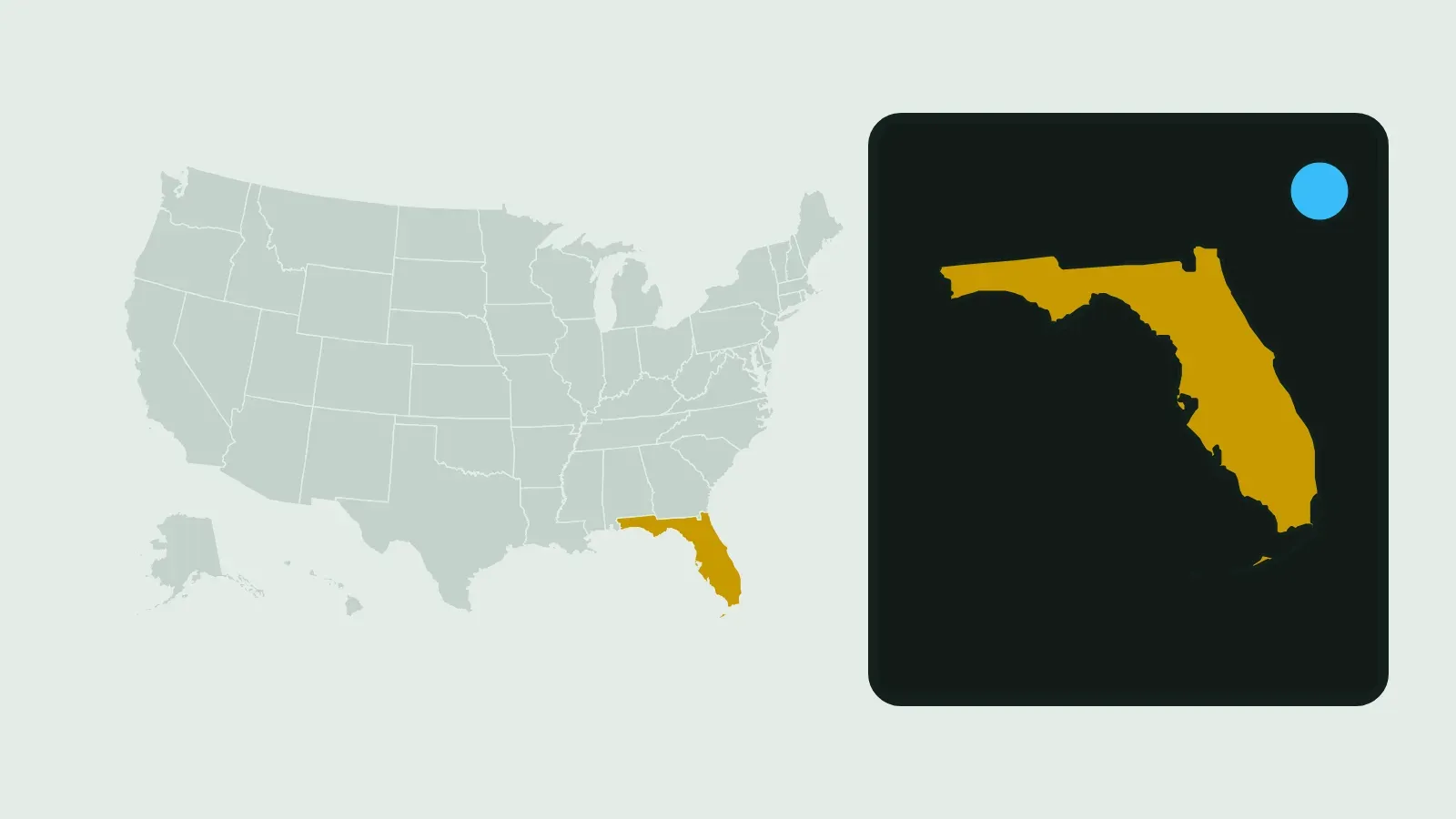
At a glance
Florida households paid an average of 15.21¢ per kWh for electricity in 2025, below the national average, and $25.48 per thousand cubic feet for natural gas, well above it. Your address decides which utility serves you. A Public Service Commission rule requires investor-owned utilities to net meter rooftop solar, with unused credits paid out at the end of each year. The state's HOMES and HEEHR rebates were still listed as expected to launch in the future.
Florida at a glance
What Floridians pay for electricity and gas
The U.S. Energy Information Administration (EIA) reports statewide averages: total residential revenue divided by kilowatt-hours sold, so delivery charges and fees are inside the figure. Your own rate depends on your utility and rate plan, so treat these as a yardstick, not a quote.
| Energy | Florida 2025 | Florida 2024 | U.S. 2025 |
|---|---|---|---|
| Electricity (¢ per kWh) | 15.21 | 14.14 | 17.23 |
| Natural gas (dollars per Mcf) | 25.48 | 25.37 | 15.34 |
At 15.21¢, a month with 1,000 kWh of use comes to about $152. Florida electricity rose about 8% between 2024 and 2025 (14.14¢ to 15.21¢) and sits about 12% below the U.S. average. Gas runs the other way: Florida households paid about 66% more per Mcf than the U.S. average, and the price was nearly flat from 2024. One Mcf holds roughly 10.37 therms, so $25.48 per Mcf is about $2.46 per therm; the kWh, therm and ccf guide explains the units on your bill.
Who sells you electricity
Your address decides which utility serves you. Check the name at the top of your bill: it may be an investor-owned company, a city-owned utility or an electric cooperative. The Florida Public Service Commission (PSC) rule on solar net metering, covered below, is written for investor-owned utilities, so city utilities and cooperatives may follow their own policies.
Because you buy from the utility that serves your address, the way to compare your cost is to read that utility's rate schedule on its website and to check each line of your bill. The electric bill guide walks through the lines.
Solar panels and what the grid pays you
Florida Administrative Code Rule 25-6.065 requires each investor-owned utility to let eligible customer-owned renewable generators net meter. The rule's history shows it was adopted in 2002 and last amended April 7, 2008. Net metering is the practice of crediting excess solar power against the power you draw from the grid.
- How exports are credited: excess generation is credited to your energy use in the next month's billing cycle.
- How long credits last: they build up and can offset your use for no more than twelve months.
- Year-end payout: unused credits are paid at an average annual rate based on the utility's COG-1 as-available energy tariff, which is a wholesale-style rate, not the retail price.
- Charges that stay: you keep paying the customer charge, and the demand charge where it applies, even when you export.
- Size tiers: the rule's interconnection tiers are 10 kW or less, over 10 kW up to 100 kW, and over 100 kW up to 2 MW.
The federal tax credit for rooftop solar ended for expenditures made after December 31, 2025. What happened to 25C and 25D explains what is left.
Home energy rebates
The Florida Department of Agriculture and Consumer Services (FDACS) runs the Florida Energy Saver Program, which is funded by about $346 million in federal money. It covers two kinds of rebate. HOMES is for whole-home upgrades that are predicted to save at least 20% of a home's energy use. HEEHR, the state's name for the electrification rebate, is for households under 150% of area median income and covers heat pumps and other efficient electric equipment.
The program page says HEEHR and HOMES are "expected to launch in the future" and that timeline information will be posted later. It gives no launch or application dates. Anyone who registers on the page is emailed when applications open. Until the state says otherwise, treat a contractor who offers a Florida rebate today as ahead of the program. How the programs work where they have launched is in the HOMES and HEAR guide, and utility rebates are a separate source worth asking about.
Who to call
- Electricity: the Florida Public Service Commission, whose Rule 25-6.065 governs net metering for investor-owned utilities.
- Your own rate: your utility's rate schedule, which names your plan and its charges.
- Rebates: the Florida Energy Saver Program at FDACS, where you can register for launch emails.
Quick answers
Can I choose my electricity supplier in Florida?
Your address decides which utility serves you, so the practical step is to read your own utility's rate schedule. The name of your utility is at the top of your bill.
Does Florida have net metering?
Yes for investor-owned utilities, under PSC Rule 25-6.065. Excess power is credited to your next month's bill, credits last up to twelve months, and unused credits are paid at year end at a rate tied to the utility's as-available energy tariff. City utilities and cooperatives may have different policies.
Are Florida home energy rebates available now?
Not according to the state's program page, which says HOMES and HEEHR are expected to launch in the future with no dates given. Register on the Florida Energy Saver Program page to get an email when applications open.
Why is Florida gas more expensive than the U.S. average?
EIA's 2025 average for Florida households was $25.48 per Mcf against $15.34 nationally. The figure blends every gas utility in the state, and your own rate depends on the utility serving your address.
Sources
- EIA — Electric Power Annual, Table 2.10, average price by state
- EIA — Average residential natural gas price by state
- Florida Administrative Code — Rule 25-6.065, Interconnection and Metering of Customer-Owned Renewable Generation
- Cornell Legal Information Institute — text of Florida Rule 25-6.065
- FDACS — Florida Energy Saver Program
Prices are EIA statewide averages. Facts on this page were checked against these sources on November 19, 2026. Rebate programs and utility policies change; confirm with your utility and the Florida Energy Saver Program before you act.
Read next
-

Bill guide
Net metering
How exported solar power is credited on a bill, how net billing differs, and where to find your rule.
-

Credits and rebates
HOMES and HEAR rebates
State-run DOE rebates and the May 2026 rule changes. Status differs by state.
-
State reading
Georgia
14.74¢ per kWh; Georgia Power rates frozen through 2028; HEAR rebate reopened in limited form.