Low
Home energy in Tennessee: prices, TVA power and what is open
Most Tennessee homes get power from a local power company that buys it from TVA, solar export terms come from those two, and the state's home energy rebates have no launch date.
By VoltHearth Editorial Team Updated 6 min read
- Electricity price
- 13.22¢ per kWh
- Natural gas price
- $11.84 per Mcf
- Pick your supplier
- No, local power company
- Net metering
- TVA and utility terms
At a glance
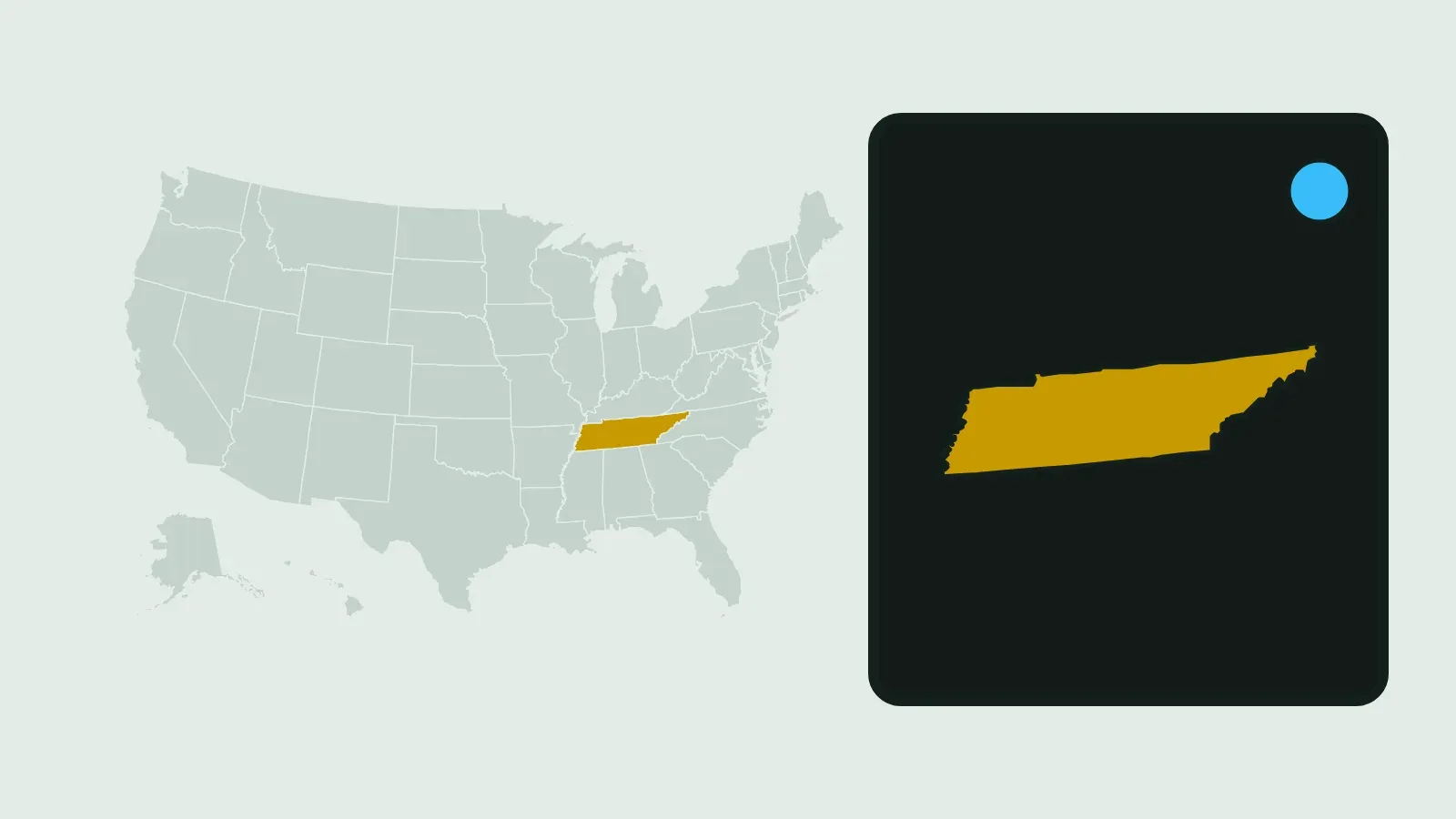
Tennessee households paid an average of 13.22¢ per kWh for electricity in 2025, well below the national average, and $11.84 per thousand cubic feet for natural gas, also below it. The Tennessee Valley Authority (TVA) serves about 99.7% of the state's electric territory through 153 local power companies, and your terms for rooftop solar come from them. The state's HOMES and HEEHR rebates had a conditional federal award and no launch date on the state's last update, June 10, 2026.
Tennessee at a glance
What Tennesseans pay for electricity and gas
The U.S. Energy Information Administration (EIA) reports statewide averages: total residential revenue divided by kilowatt-hours sold, so delivery charges and fees are inside the figure. Your own rate depends on your local power company, rate schedule and season, so treat these as a yardstick, not a quote.
| Energy | Tennessee, 2025 and 2024 | U.S., 2025 and 2024 |
|---|---|---|
| Electricity (¢ per kWh) | 13.22 and 12.42 | 17.23 and 16.48 |
| Natural gas (dollars per Mcf) | 11.84 and 10.75 | 15.34 and 14.50 |
At 13.22¢, a month with 1,000 kWh of use comes to about $132.20. Tennessee electricity rose about 6% between 2024 and 2025 (12.42¢ to 13.22¢) and stayed about 23% below the U.S. average. Gas rose about 10% and ran about 23% below the U.S. average. One Mcf holds roughly 10.37 therms, so $11.84 per Mcf is about $1.14 per therm; the kWh, therm and ccf guide explains the units on your bill.
Who sells you electricity
The Tennessee State Energy Office says TVA, a federally owned corporation, serves about 99.7% of the state's electric service territory, and that "TVA regulates the 153 local power companies (LPCs) that distribute TVA power in the Tennessee Valley region." The one distribution utility not served by TVA, Appalachian Power, is regulated by the Tennessee Public Utility Commission. The Tennessee Advisory Commission on Intergovernmental Relations describes TVA as the federal utility providing electricity to almost every community in the state.
Your bill comes from a local power company. EIA's 2024 state table lists 103.0 million MWh of full-service provider sales and 0 MWh of energy-only provider sales for Tennessee. The pages we opened do not state a supplier choice rule, so confirm with your local power company. The rate structures guide shows how to read the schedule on your bill.
Solar panels and what the grid pays you
TVA describes two programs on its renewable energy page. Dispersed Power Production lets residential, business and industry customers sell power from qualified facilities to TVA. Green Connect offers homeowners free resources for the safe and reliable installation of solar panels or solar with batteries. The page does not give payment rates, eligibility or size limits, and we could not confirm a statewide net metering rule from the pages we opened.
The federal tax credit for rooftop solar ended for systems finished after December 31, 2025, so the export rate now carries more of the payback. What happened to 25C and 25D explains what is left.
Home energy rebates
The Tennessee Department of Environment and Conservation (TDEC) will run two federally funded programs: HOMES, rebates for whole-home efficiency work, and HEEHR, the statute's name for the electric appliance rebates that many sources call HEAR. TDEC lists allocations of $83,708,676 for HOMES and $83,390,060 for HEEHR. For HOMES in a single-family home, it lists up to $4,000 for 20% to 34% modeled savings and up to $8,000 for 35% or more, for households below 80% of area median income, and half those amounts at or above it. Multifamily buildings can receive up to $400,000.
For HEEHR, TDEC lists a maximum of $14,000 per building, with caps of $8,000 for a heat pump, $1,750 for a heat pump water heater and $4,000 for an electrical service upgrade. On the page, last updated June 10, 2026, the state says funding is not yet available. DOE gave Tennessee a conditional award in January 2025, and the state still needs full DOE approval and an executed agreement, then must finish contracting with TVA. No launch date is set. How the programs work elsewhere is in the HOMES and HEAR guide.
What is distinctive about Tennessee's power
EIA's Tennessee profile says nuclear plants supplied 48% of in-state electricity in 2023, natural gas 19% and hydroelectric power 12%, and that Tennessee is the sixth-largest hydroelectric producer in the country. It also says TVA owns more than 90% of the state's generating capacity. The profile was last updated in October 2024.
Who to call
- Electricity from TVA power: your local power company, which TVA regulates; TVA's Renewables Call Center handles solar program questions.
- Appalachian Power customers and gas utilities: the Tennessee Public Utility Commission, which sets rates and service standards of privately owned telephone, natural gas, electric and water utilities.
- Rebates: the State Energy Office at TDEC.
Quick answers
Can I choose my electricity supplier in Tennessee?
The sources we opened describe service through local power companies that buy TVA power, and EIA's 2024 table shows no energy-only provider sales. They do not state a supplier choice rule, so confirm with your local power company.
Does Tennessee have net metering?
We could not confirm a statewide rule. TVA's Dispersed Power Production program lets customers sell power from qualified facilities to TVA, and your local power company can tell you what it pays for exports.
Are Tennessee home energy rebates available now?
Not on the state's page, last updated June 10, 2026. Tennessee had a conditional DOE award, still needed full approval and an executed agreement, and had no launch date.
Why is my Tennessee electricity price below the U.S. average?
EIA's 2025 average for Tennessee households was 13.22¢ per kWh against 17.23¢ nationally. EIA's profile shows nuclear, gas and hydro supply the state's power, but it does not say that this sets your rate, and your own rate depends on your local power company.
Sources
- EIA — Electric Power Annual, Table 2.10, average price by state
- EIA — Average residential natural gas price by state
- EIA — Tennessee state profile
- EIA — Tennessee electricity profile (2024 data)
- Tennessee State Energy Office — Solar energy (updated August 11, 2026)
- Tennessee Advisory Commission on Intergovernmental Relations — Managing solar energy development (September 2023)
- TVA — Valley renewable energy
- Tennessee Public Utility Commission
- TDEC — Home energy rebate programs (updated June 10, 2026)
Prices are EIA statewide averages. Facts on this page were checked against these sources on November 19, 2026. TVA and local power company policies, and rebate programs, change; confirm with your local power company and TDEC before you act.
Read next
-
Bill guide
Rate structures explained
Flat, tiered, time-of-use and demand rates, with a worked example and how to find your tariff.
-
Credits and rebates
HOMES and HEAR rebates
State-run DOE rebates and the May 2026 rule changes. Status differs by state.
-
State reading
Alabama
16.09¢ per kWh; utility-set rates; no net metering; home energy rebates under development.