Moderate
Home energy in Texas: prices, who sells you power and what is open
Most Texans can shop for an electricity plan, solar export credits depend on the provider, and the state's home energy rebates have not opened yet. Here is how each part works.
By VoltHearth Editorial Team Updated 6 min read
- Electricity price
- 15.40¢ per kWh
- Natural gas price
- $19.42 per Mcf
- Pick your supplier
- Most areas, not all
- Net metering
- No statewide rule
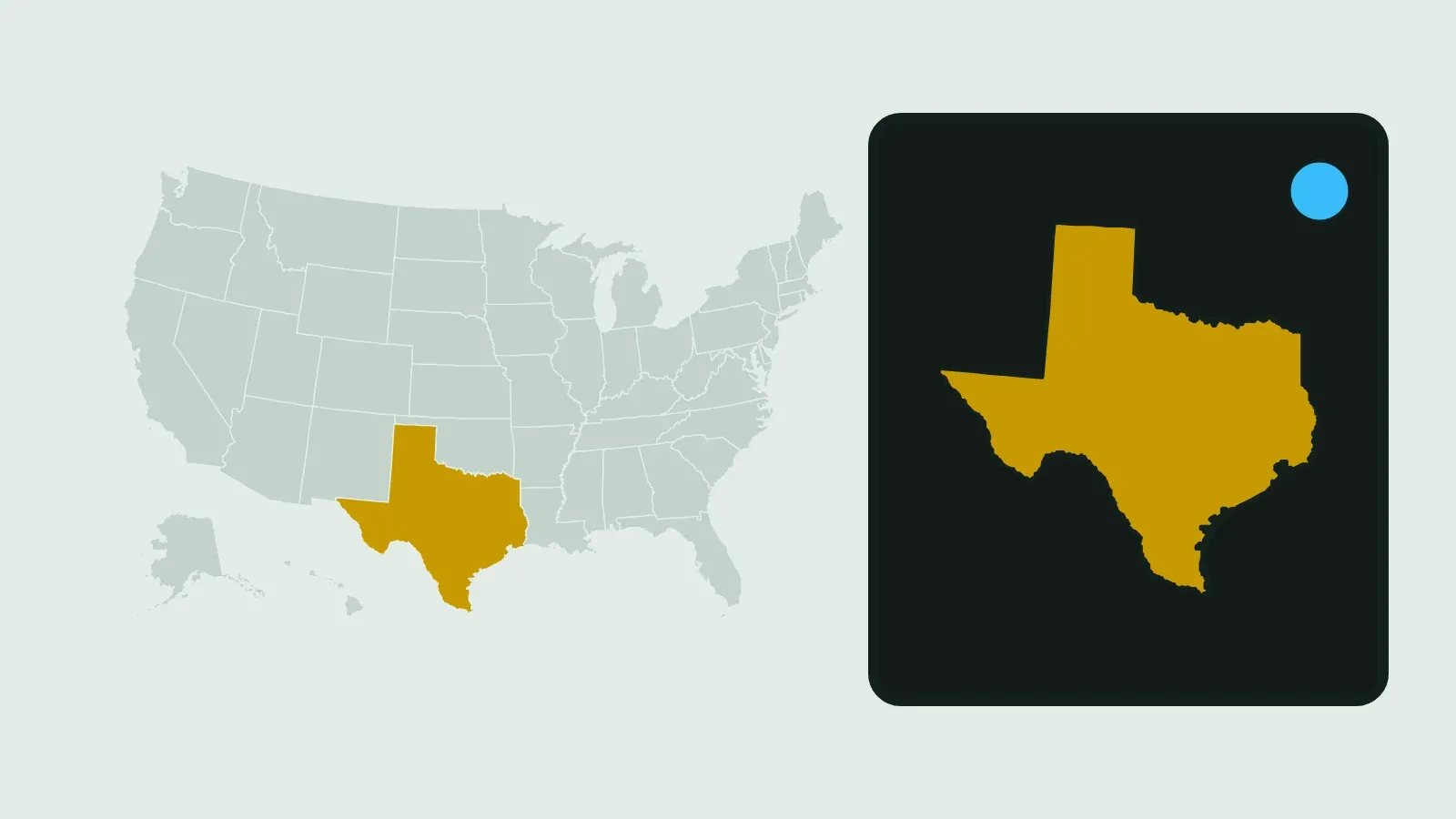
At a glance
Texas households paid an average of 15.40¢ per kWh for electricity in 2025, below the national average, and $19.42 per thousand cubic feet for natural gas, above it. Most Texans choose their own electricity provider; city-owned utilities and many co-ops do not offer that choice. There is no statewide net metering rule for rooftop solar, and the state's HOMES and HEAR rebates were still in planning on the state's last update.
Texas at a glance
What Texans pay for electricity and gas
The U.S. Energy Information Administration (EIA) reports statewide averages: total residential revenue divided by kilowatt-hours sold, so delivery charges and fees are inside the figure. Your own rate depends on your provider, plan and season, so treat these as a yardstick, not a quote.
| Energy | Texas 2025 | Texas 2024 | U.S. 2025 |
|---|---|---|---|
| Electricity (¢ per kWh) | 15.40 | 14.94 | 17.23 |
| Natural gas (dollars per Mcf) | 19.42 | 17.98 | 15.34 |
At 15.40¢, a month with 1,000 kWh of use comes to about $154. Texas electricity rose about 3% between 2024 and 2025 (14.94¢ to 15.40¢). Gas is the reverse of electricity: Texas households paid about 27% more per Mcf than the U.S. average. One Mcf holds roughly 10.37 therms, so $19.42 per Mcf is about $1.87 per therm; the kWh, therm and ccf guide explains the units on your bill.
Who sells you electricity
Texas opened its retail electricity market to competition in 2002. Where it applies, you pick a retail electric provider (REP) and a plan, while a separate delivery utility, such as CenterPoint in the Houston area or Oncor in much of Dallas-Fort Worth, keeps owning the poles and wires, reading the meter and restoring power after an outage. You cannot choose the delivery utility, and switching provider does not change it.
- Where you can choose: about 85% of Texas customers, including the Houston and Dallas-Fort Worth regions, according to a 2026 summary of ERCOT's retail market.
- Where you cannot: areas served by municipal utilities and electric cooperatives that did not opt in, such as Austin and San Antonio, plus some territory outside the ERCOT grid.
- Where to compare plans: the Public Utility Commission of Texas runs the Power to Choose comparison site for the choice areas.
Plans differ on fixed or variable price, contract length, cancellation fees and bill credits that switch on at a usage level. The retail choice guide shows how to compare them on the total bill at your own usage instead of the headline rate.
Solar panels and what the grid pays you
Texas has no statewide net metering policy, the rule in many states that credits excess solar power at the retail rate. What you get for exports depends on who serves you. In choice areas, only some retail providers offer a solar buyback plan, and their terms differ. City utilities and co-ops set their own policies.
The federal tax credit for rooftop solar ended for systems finished after December 31, 2025, so the buyback rate now carries more of the payback. What happened to 25C and 25D explains what is left.
Home energy rebates
The Texas State Energy Conservation Office (SECO) will run two federally funded programs: HOMES, rebates for whole-home efficiency work, and HEAR, rebates for electric appliances and equipment. The Department of Energy allocated $690 million to Texas for both. SECO lists maximums of $8,000 for HOMES and $14,000 per household for HEAR.
On its last status update, August 21, 2026, SECO said the programs were in planning and design and that no launch date was set. It also advises against signing any agreement tied to the programs before they launch and a list of approved contractors exists. A contractor who says Texas rebate money is available today is ahead of the state. How the programs work elsewhere is in the HOMES and HEAR guide.
Who to call
- Electricity: the Public Utility Commission of Texas oversees delivery utilities and retail electric providers in the choice areas.
- Natural gas: the Railroad Commission of Texas has original jurisdiction over gas utility rates outside city limits and over pipelines. Inside a city, the city itself oversees the rates its gas utility charges.
- Rebates: the State Energy Conservation Office at the Texas Comptroller.
Quick answers
Can I choose my electricity provider in Texas?
In most of the state, yes, including the Houston and Dallas-Fort Worth areas. Customers of city-owned utilities and many co-ops, such as in Austin and San Antonio, generally cannot. Your bill names your delivery utility; the Power to Choose site shows whether your address has plans to compare.
Does Texas have net metering?
Not as a statewide rule. Whether you get credit for excess solar power depends on your retail provider or local utility, and the credit rate varies.
Are Texas home energy rebates available now?
Not as of the state's August 21, 2026 update. HOMES and HEAR were in planning with no launch date. Check the State Energy Conservation Office page before you start work you hope a rebate will cover.
Why is my Texas gas price higher than the U.S. average?
EIA's 2025 average for Texas households was $19.42 per Mcf against $15.34 nationally. Delivery charges, distance from supply and fixed monthly charges all feed a utility's average, and your own rate depends on the utility serving your city.
Sources
- EIA — Electric Power Annual, Table 2.10, average price by state
- EIA — Average residential natural gas price by state
- ERCOT — Retail market: choice areas and non-opt-in entities
- Texas Comptroller — State Energy Conservation Office, home energy rebates
- Railroad Commission of Texas — Natural gas rates FAQs
- Community Impact — Texas electricity systems explained (July 2, 2026)
Prices are EIA statewide averages. Facts on this page were checked against these sources on November 19, 2026. Rebate programs and utility policies change; confirm with your provider and the State Energy Conservation Office before you act.
Read next
-
Bill guide
Retail choice plans
What you can switch when you pick an electricity supplier, plan types, and how to compare offers.
-

Bill guide
Net metering
How exported solar power is credited on a bill, how net billing differs, and where to find your rule.
-

Credits and rebates
HOMES and HEAR rebates
State-run DOE rebates and the May 2026 rule changes. Status differs by state.