Moderate
Home energy in Iowa: prices, who sells you power and what is open
Your utility sells you electricity, solar export credits follow a utility tariff, and the state's home energy rebates had not launched on the state's last posted update. Here is how each part works.
By VoltHearth Editorial Team Updated 6 min read
- Electricity price
- 13.62¢ per kWh
- Natural gas price
- $10.61 per Mcf
- Pick your supplier
- No energy-only suppliers
- Net metering
- Utility-specific tariffs
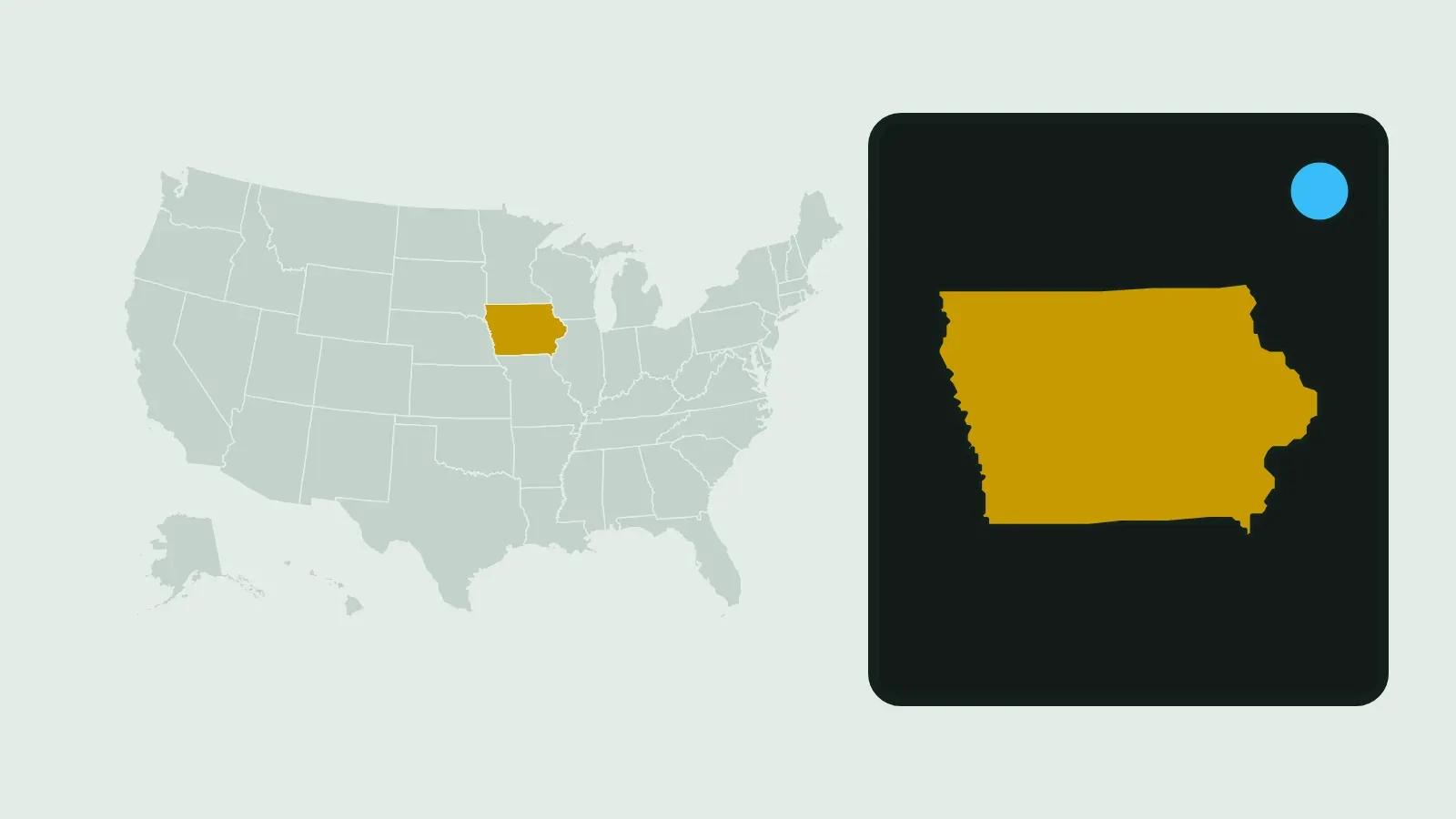
At a glance
Iowa households paid an average of 13.62¢ per kWh for electricity in 2025, below the national average, and $10.61 per thousand cubic feet for natural gas, also below it. EIA reports no energy-only supplier sales in Iowa, so the utility that serves your address sells you the power. The two rate-regulated electric utilities credit rooftop solar exports through net billing or inflow-outflow tariffs, and the state's HOMES and HEAR rebates were listed as not yet available on the state's last posted update.
Iowa at a glance
What Iowans pay for electricity and gas
The U.S. Energy Information Administration (EIA) reports statewide averages: total residential revenue divided by kilowatt-hours sold, so delivery charges and fees are inside the figure. Your own rate depends on your utility, rate class and season, so treat these as a yardstick, not a quote.
| Energy | Iowa 2025 | Iowa 2024 | U.S. 2025 |
|---|---|---|---|
| Electricity (¢ per kWh) | 13.62 | 13.40 | 17.23 |
| Natural gas (dollars per Mcf) | 10.61 | 10.33 | 15.34 |
At 13.62¢, a month with 1,000 kWh of use comes to about $136. Iowa electricity rose about 2% between 2024 and 2025 (13.40¢ to 13.62¢) and sat about 21% below the U.S. average. Gas was about 31% below the U.S. average per Mcf. One Mcf holds roughly 10.37 therms, so $10.61 per Mcf is about $1.02 per therm; the kWh, therm and ccf guide explains the units on your bill.
Who sells you electricity
In Iowa the utility serving your address is the seller. EIA's 2024 state profile shows all of the state's retail electricity sales as full-service sales and none as energy-only sales, the category that marks retail choice. The Iowa Utilities Commission (IUC) counts 181 electric utilities in 2025 (total customers: 1,723,353).
- Investor-owned: 2 utilities; customers: 1,249,609, about 72.5% of the total. The IUC regulates their rates and services.
- Municipal: 135 utilities; customers: 224,854, about 13.1%.
- Rural electric cooperatives: 44 utilities; customers: 248,890, about 14.4%.
For municipal utilities and cooperatives the IUC's authority is limited to service, safety and engineering, not rates. Ask your utility how its rates are set and where to read its tariff. The rate structures guide shows what the lines mean.
Solar panels and what the grid pays you
Iowa law (Iowa Code section 476.49) requires the two rate-regulated electric utilities, MidAmerican Energy and Interstate Power and Light, to file a tariff for customer-owned generation using either net billing or inflow-outflow billing. Under net billing, exports earn kilowatt-hour credits that offset later usage. Under inflow-outflow, exports earn dollar credits at the outflow purchase rate that offset per-kWh charges in later periods. In both cases you still pay the other charges on your bill.
- MidAmerican: inflow-outflow tariff (Rate IO), approved November 24, 2020.
- Interstate Power and Light: inflow-outflow tariff (Rate Code IO) and a net metering pilot (Rate Code NM), both approved December 30, 2020.
- Municipal and co-op utilities: the IUC's authority over them is limited to service, safety and engineering, so ask your utility what it offers.
The federal tax credit for rooftop solar ended for systems finished after December 31, 2025, so the export credit now carries more of the payback. What happened to 25C and 25D explains what is left.
Home energy rebates
The Iowa Energy Office, part of the Iowa Economic Development Authority, planned two federally funded programs: HOMES, whole-home efficiency rebates, and a second program for electric appliances that its page calls HEEHRA and that DOE calls HEAR. The page expected more than $60 million for HOMES, with rebates of $2,000 to $8,000 for individual households and up to $400,000 for multifamily buildings. It expected about $60 million for the appliance program, with a percentage of project cost based on household income, capped at $14,000.
The page says the rebates were "not yet available" and that the office was reviewing the guidelines. It gave mid-2025 as an expectation, not a date, and its last update is January 29, 2025, so it does not tell you whether the programs opened later. DOE's own rebate page, updated July 8, 2026, says the rebates are available in select states without naming them. Do not start work counting on an Iowa rebate until the state office says it is open. How the programs work is in the HOMES and HEAR guide.
Who to call
- Electricity: the Iowa Utilities Commission regulates rates and services of investor-owned utilities and has limited authority over municipal utilities and cooperatives.
- Rebates: the Iowa Energy Office at the Iowa Economic Development Authority.
- Municipal or co-op customers: your utility's own office, since the IUC does not set those rates.
What is distinctive about energy in Iowa
EIA lists wind as Iowa's primary source of electricity generation. In 2024 the state's net generation was about 70.5 million megawatt-hours, against about 54.9 million megawatt-hours of retail sales. That is generation inside the state, not what reaches your meter, which depends on the utility that serves you. To see how a bill is built, start with the electric bill guide.
Quick answers
Can I choose my electricity provider in Iowa?
EIA's 2024 profile shows no energy-only retail sales in Iowa, which means the utility serving your address sells you the power. Your bill names that utility.
Does Iowa have net metering?
Not as one statewide formula. MidAmerican and Interstate Power and Light file net billing or inflow-outflow tariffs under state law, and municipal and cooperative utilities have their own policies. Ask your utility for the tariff in writing.
Are Iowa home energy rebates available now?
The state's page, last updated January 29, 2025, said not yet. No later state notice was found, so check with the Iowa Energy Office before you start work you hope a rebate will cover.
Why is Iowa gas cheaper than the U.S. average?
EIA's 2025 average for Iowa households was $10.61 per Mcf against $15.34 nationally. EIA's averages do not say why, and your own rate depends on the utility serving your city.
Sources
- EIA — Electric Power Annual, Table 2.10, average price by state
- EIA — Average residential natural gas price by state
- EIA — Iowa electricity profile
- Iowa Utilities Commission — Customer-owned generation
- Iowa Utilities Commission — Iowa's electric profile
- Iowa Economic Development Authority — Residential energy efficiency programs
- U.S. Department of Energy — Home Energy Rebates
Prices are EIA statewide averages. Facts on this page were checked against these sources on November 19, 2026. Rebate programs and utility tariffs change; confirm with your utility and the Iowa Energy Office before you act.
Read next
-
Bill guide
Net metering
How exported solar power is credited on a bill, how net billing differs, and where to find your rule.
-
Credits and rebates
HOMES and HEAR rebates
State-run DOE rebates and the May 2026 rule changes. Status differs by state.
-
State reading
Kansas
14.44¢ per kWh; your utility sells the power; net metering at Evergy and Liberty; rebates not open yet.